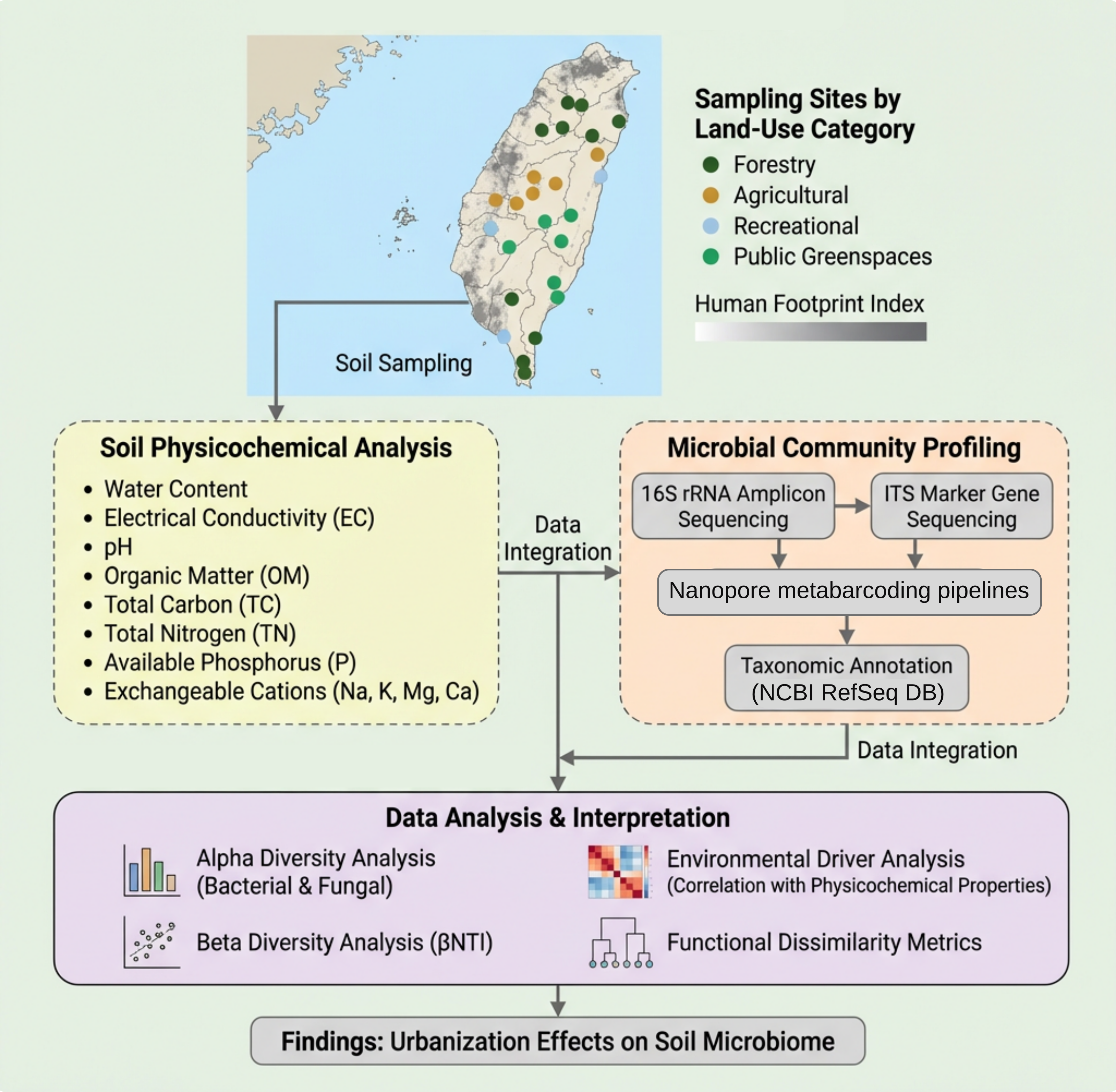
Urbanization alters soil properties and reshapes belowground microbial communities, yet the extent and mechanisms of these changes remain poorly characterized in subtropical regions. This project investigates how urbanization gradients affect soil microbial diversity, community assembly, and functional potential across Taiwan.
We collect soils from sites spanning four land-use categories—forestry, agricultural, recreational, and public greenspaces—stratified by the Human Footprint Index. Soil physicochemical properties (pH, organic matter, total carbon and nitrogen, available phosphorus, exchangeable cations) are measured alongside bacterial and fungal community profiling via 16S rRNA and ITS amplicon sequencing using Oxford Nanopore metabarcoding pipelines. Integrated analyses of alpha and beta diversity (βNTI), environmental driver correlations, and functional dissimilarity metrics are applied to evaluate whether urbanization drives taxonomic and functional homogenization of soil microbiomes, and whether bacteria and fungi respond synchronously or asynchronously to land-use change.
This work aims to provide a regional-scale framework for understanding urbanization impacts on soil biodiversity and ecosystem function in a rapidly developing subtropical island.